
The Send Engine should respond to pressure, not keep charging because somebody clicked a button.
Advanced Subscriber Intelligence treats campaign sending as a controlled operating system. The Freight Train send engine moves eligible recipients through provider-aware queues while ASI monitors pressure, pacing, holds, bounces, safety state, and the evidence being written underneath.
The operator sees clear campaign and queue controls through the custom ASI interface. ASI Core decides what is eligible, what is held, what can move, what must stop, and which provider lane needs different treatment.
Sending does not outrank validation, suppression, consent, Preflight, Queue Safety, or current SQL truth. The dashboard asks. Core decides.
Provider-Aware Pacing
Google MX Protected Lane
Queue Safety Before Damage
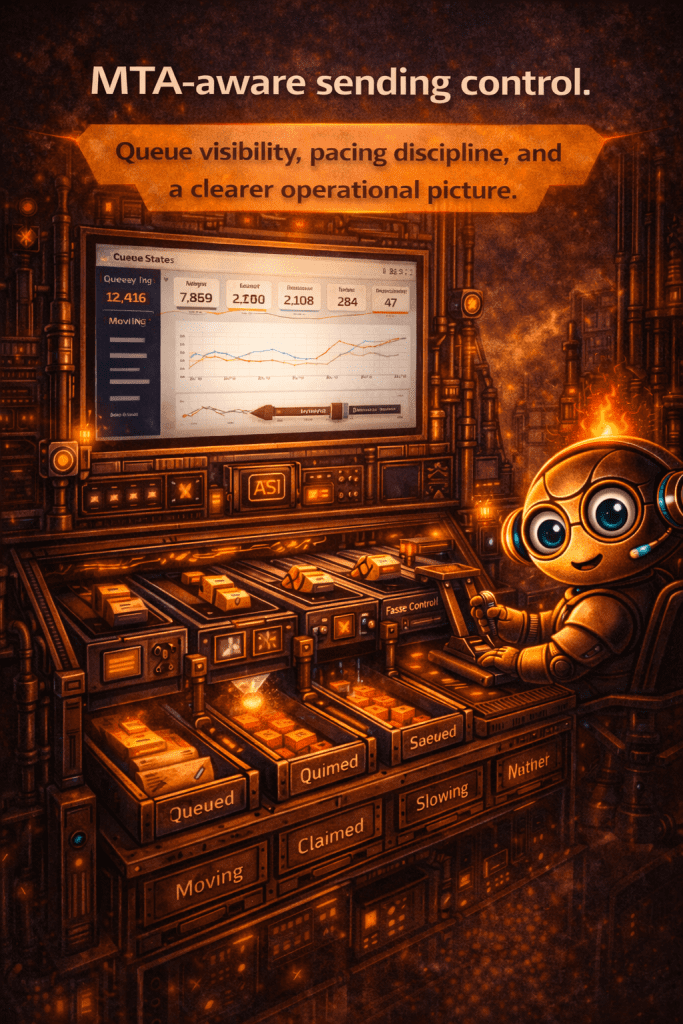
The campaign can only move while the protection rails agree.
ASI does not treat a queued campaign as an instruction to ignore everything that happens next. Current eligibility, suppression, provider pressure, queue state, bounce evidence, safety thresholds, and operational health continue to matter while sending is underway.
Simple for the operator. Serious underneath.
The daily workflow stays clear while ASI handles the deeper operational decisions below the surface.
Choose the audience
Run Review and Preflight
Queue the send
Watch the operation
Review the evidence
Underneath that flow, ASI is enforcing subscriber truth, building queue rows, separating provider lanes, applying pacing, checking pressure, capturing transport evidence, and deciding whether the campaign remains safe to continue.
From approved campaign to controlled delivery.
Each stage has a distinct job. Queueing is not the end of protection. It is the point where live operational protection begins.
Campaign readiness
The campaign, sender identity, approved content, audience, consent, suppression, and required compliance conditions must be in place.
Draft Content Review
Content and subject evidence is reviewed before queue creation so obvious risk does not reach the sending layer unnoticed.
Preflight
The chosen audience is checked again against current suppression, bounce, hold, validation, eligibility, and reputation evidence.
Queue creation
Eligible recipients become SQL-owned queue rows with campaign, subscriber, provider, message, and operational context.
Provider lanes
Recipients move through provider-aware handling rather than one blunt speed for every mailbox network.
Freight Train movement
Workers claim bounded work, move it through the sending environment, and write operational state back to Core.
Feedback and protection
Delivery, rejection, bounce, queue, provider, and safety evidence can slow, hold, pause, or stop future movement.
Evidence and reporting
Message traceability, campaign reporting, bounce evidence, provider behaviour, and recipient events remain available after the send.
A modern queue-aware send engine, not a one-speed mail cannon.
The Freight Train moves bounded work through the private ASI sending environment while respecting queue state, provider pacing, operational locks, warm-up rules, and current Core truth.
Bounded work
Workers claim controlled batches rather than trying to push an entire campaign through one uncontrolled action.
Visible state
Queued, pending, claimed, spooled, sent, held, failed, and suppressed states remain part of the operating picture.
Controlled recovery
Recoverable work can be retried or resumed without pretending every failure deserves an immediate second shove.
SQL-owned truth
Queue and sending state belong to the authoritative SQL Core. Caches and prepared views may accelerate visibility, but they do not outrank Core.
Google-owned inboxes have their own protected lane.
Google traffic is too commercially important to be treated as ordinary queue volume. ASI separates it so pacing, holds, recovery, reputation evidence, and operator visibility can be managed independently.
Separate pacing
Google MX volume can move at a different rate from other providers rather than inheriting one global speed.
Protected holds
When Google evidence becomes unsafe, the Google lane can be held without forcing unrelated provider traffic to behave the same way.
Google-only tail protection
When only Google MX recipients remain, ASI can hold that tail and allow the operation to move on rather than repeatedly hammering one provider.
Evidence-led recovery
Recovery decisions use current provider, queue, campaign, content, rejection, and reputation evidence rather than a blind timer.
Reputation is built through controlled behaviour, not purchased with the server.
Each private ASI environment uses a dedicated sending IP and controlled domain. The domain provides a vetted starting foundation, but the domain and IP still build reputation together through ASI’s ten-week warm-up.
Controlled growth
Volume rises through approved warm-up stages rather than jumping from a quiet environment to full licensed capacity.
Provider-aware pacing
Different providers can require different treatment based on current evidence, reputation, and queue pressure.
List quality remains part of warm-up
Warm-up does not excuse weak data. Validation, suppression, consent, Preflight, and Queue Safety still apply.
No instant migration of reputation
Previous sending history may inform planning, but a new domain and IP must still establish their own reputation through real sends.
The safest campaign may be the one ASI stops before the sender notices the damage.
Queue Safety watches the live evidence surrounding the send. When risk crosses the protected threshold, the correct response is not to decorate the warning. It is to stop movement and make the evidence visible.
Safety lock
Protected thresholds can prevent further movement when bounce, queue, provider, or campaign evidence indicates unacceptable risk.
Evidence before release
The operator reviews the Safety Report and the reason for the lock before any controlled release is allowed.
No reputation gambling
The platform is designed to remove risk and require corrective action, not provide a convenient override button beside the warning.
Auditable action
The lock, report, operator action, release, and later outcome remain part of the operational evidence trail.
Pause, resume, hold, stop, and recover with the reason still attached.
Operational controls are useful only when they respect the underlying queue state and leave an evidence trail.
Pause
Stop new work being claimed while preserving the queue and current campaign state for review.
Resume
Continue eligible work only after the relevant hold, lock, or operational concern has been resolved.
Hold
Keep a provider lane, recipient family, campaign, or risk class away from movement without rewriting subscriber truth.
Stop and clean up
End unsafe movement, reconcile queue state, and preserve the evidence needed to understand what happened.
Not every rejection means the same thing.
ASI captures response evidence so mailbox failure, temporary rejection, provider reputation pressure, complaint-related behaviour, and permanent invalidity are not flattened into one crude bounce counter.
Hard failure
Permanent mailbox or domain failure can change subscriber eligibility and remove the record from future ordinary sending.
Temporary failure
Recoverable conditions may create a bounded hold, retry, or review path without pretending the record is healthy forever.
Provider reputation pressure
A provider-specific rejection can trigger lane protection and campaign review without being misclassified as an ordinary hard bounce.
Forensic evidence
Subscriber, campaign, queue, message, SMTP response, diagnostic, bounce class, source, and raw response context can support later investigation.
The sending environment should be visible before a customer notices the problem.
ASI Operations Control Room monitors the infrastructure and operational state surrounding the Send Engine so queue, worker, DNS, provider, service, and system concerns can be surfaced early.
Queue and worker state
Monitor whether the queue is moving, whether workers are alive, and whether pressure is building unexpectedly.
Infrastructure health
Watch the wider server and service environment that supports validation, queueing, sending, bounce handling, and reporting.
Operational evidence
Diagnostics, health signals, incident context, and controlled support packets make investigation less dependent on guesswork.
Client-controlled support access
ASI support access remains permissioned, bounded, visible, and auditable rather than giving ASI unrestricted access to client data.
One client. One server. One IP. One ASI.
ASI operates on purpose-built Linux infrastructure with a custom ASI interface. The sending lane is dedicated to the licensed client rather than mixed with unrelated senders inside a shared pool.
Dedicated reputation
The client builds and protects its own domain and IP reputation rather than inheriting the behaviour of strangers.
Licensed daily capacity
Capacity is licensed around the operating tier, not charged as a subscriber tax on every record in the database.
Scale without replacing the workflow
Commercial tiers can grow through licence and infrastructure uplift without rebuilding the operator experience from scratch.
Enterprise Linux systems
Larger 500,000 and 1,000,000-email-per-day systems use the full Linux-native enterprise architecture and structured implementation path.
The Send Engine does not finish its job when the message leaves the server.
Campaign, queue, message, provider, bounce, unsubscribe, abuse, and recipient-event evidence feeds the protected reporting rails used to understand what happened.
Reports Builder
Campaign evidence can be scoped, filtered, reviewed, exported, and packaged through the protected reporting rail.
Event Stream
The activity beneath the totals remains visible, including opens, clicks, confidence evidence, bots, scanners, and other events.
Recipient Drilldown
Recipient-level evidence supports investigation without pretending every event can be reduced to absolute certainty.
Operational reporting
ASI reporting is designed to provide up to 92% accurate operational data and preserve the reasoning beneath the result.
For businesses where sending failure has a commercial cost.
ASI is built for established B2B senders, high-volume operators, WooCommerce businesses, sales-led organisations, dedicated agency environments, and teams that need operational control rather than a decorative send button.
Not every sender needs a Freight Train.
ASI is not designed for casual newsletters, reckless list blasting, unauthorised multi-client backend use, or operators who want safety warnings to move politely out of the way.
Explore the surrounding ASI rails
Continue into Google MX Protection, Email Warm-Up, Private Linux Infrastructure, ASI Operations Control Room, Campaign Reports & Insights, and Email Compliance.
Sending should be controlled while it is happening, not reconstructed after the damage.
Request a private Sender Review to examine your current send engine, queue visibility, provider pacing, warm-up, Google MX exposure, bounce handling, safety controls, infrastructure, and reporting evidence.