
Why does Google MX have its own lane?
Because Google-owned inboxes are too commercially important to be treated as ordinary queue volume.
Advanced Subscriber Intelligence separates Gmail and Google-hosted business inboxes into a protected provider lane with its own pacing, warm-up eligibility, hold rules, recovery behaviour, rejection handling, and evidence.
The purpose is not to send faster. It is to protect the sender before Google reputation pressure becomes a full rejection problem.
Explicit Consent During Warm-Up
Google-Only Tail Holds
Evidence-Led Recovery
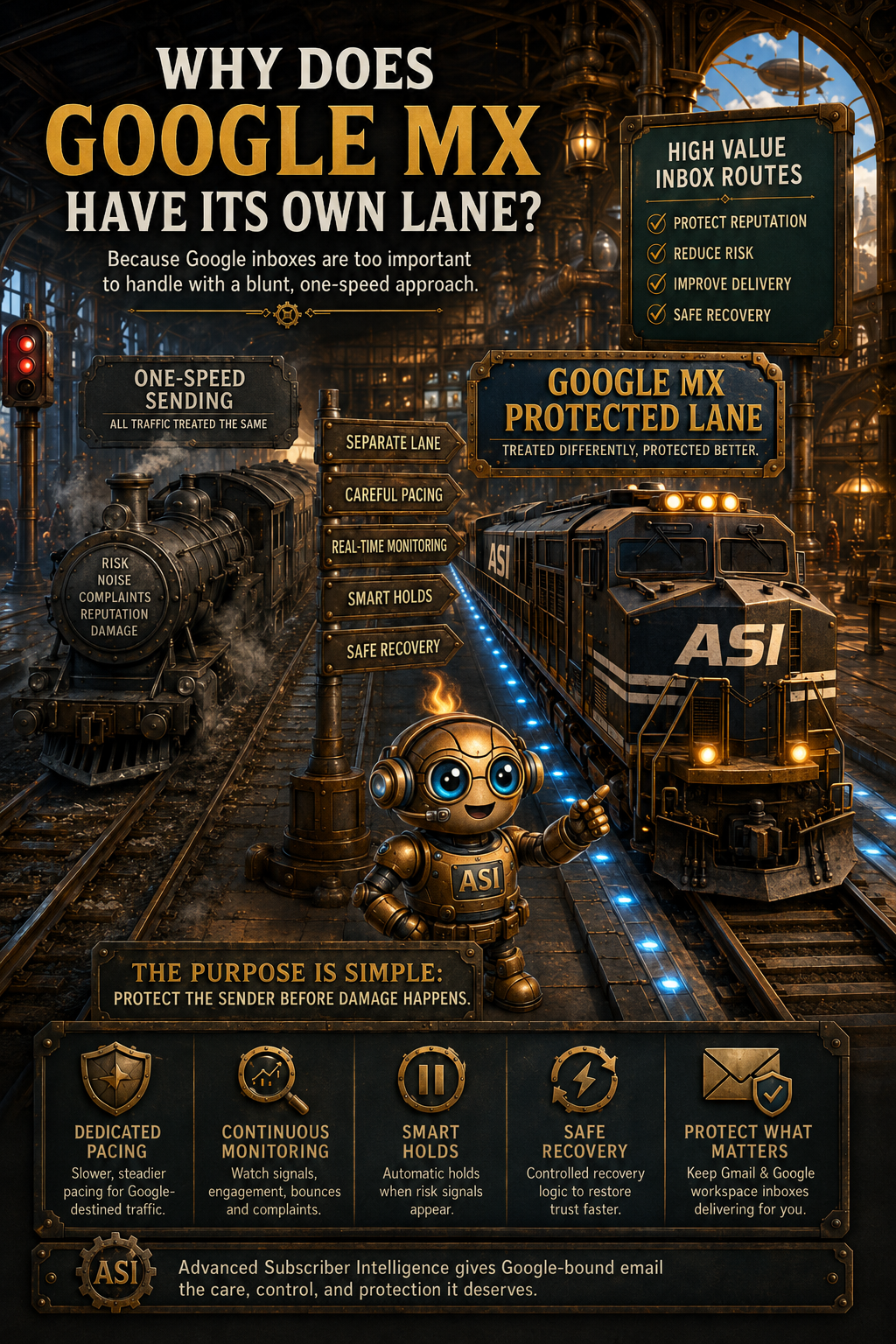
One provider’s danger signal should not be hidden inside one global sending speed.
Google traffic can represent a large and commercially important part of an audience. Separating it gives ASI the ability to react to Google-specific reputation pressure without pretending every provider is experiencing the same conditions.
Why a separate Google lane matters
Google reputation pressure can behave differently from ordinary mailbox failure, so ASI gives it different operational treatment.
Commercial importance
Gmail and Google-hosted business inboxes may represent a substantial part of real customer, prospect, and account communication.
Provider-specific pressure
Google rejections, pacing sensitivity, engagement signals, and reputation concerns should not be flattened into ordinary queue behaviour.
Independent control
ASI can slow or hold Google-bound traffic while other provider lanes continue under their own current evidence.
Safer diagnosis
Separate evidence makes it easier to distinguish mailbox failure, content risk, reputation rejection, queue pressure, and a provider-specific incident.
Separate, qualify, pace, watch, hold, recover.
The lane remains part of ASI Core. It is not a second sending engine and it does not create separate subscriber truth.
Identify Google MX traffic
Recipients whose destination routes through Google-owned mail infrastructure are separated into the protected Google lane.
Apply lane eligibility
Validation, consent, suppression, bounce, hold, campaign, and warm-up rules determine whether the recipient may enter the lane.
Use separate pacing
Google-bound traffic follows its own pacing and skip behaviour instead of inheriting one global send rate.
Watch provider evidence
Rejections, bounce classes, campaign timing, queue state, content evidence, operator actions, and reputation signals remain visible.
Hold before damage
When current Google evidence is unsafe, ASI can slow or hold the lane without rewriting subscriber truth or globally stopping unrelated providers.
Recover under evidence
Recovery uses controlled pacing, qualifying sends, current reputation evidence, and bounded re-entry rather than immediately returning to the previous rate.
During warm-up, unknown consent does not enter the Google lane.
Google MX warm-up recipients must have explicit marketing consent recorded as Yes. Blank, null, unknown, or ambiguous consent is treated as No for Google warm-up eligibility.
Automatic lane exclusion
A record without explicit consent is excluded automatically from the Google warm-up lane instead of creating a Preflight approval question.
No truth rewriting
Exclusion does not rewrite the subscriber as globally unsubscribed or suppressed. It records why the recipient was not eligible for this protected lane.
Protect the starting reputation
The warm-up audience begins with the clearest available permission evidence instead of using unknown records to test a sensitive provider relationship.
Core owns the reason
The current ASI Core evidence records the lane decision. The dashboard does not invent a second eligibility state.
When only Google MX remains, ASI does not keep hammering the same provider.
A campaign can reach the point where every non-Google recipient has completed and only the protected Google lane remains. ASI can hold that remaining tail and move the wider operation forward.
Avoid repeated pressure
The system does not repeatedly cycle through a Google-only queue merely because those rows are the last ones standing.
Preserve the queue
The held Google rows remain visible and recoverable. They are not silently deleted, marked sent, or globally suppressed.
Move to the next send safely
Other eligible work can continue without forcing the Google lane to absorb unnecessary pressure merely to make one campaign look complete.
Leave evidence behind
The hold reason, queue state, campaign context, provider lane, and later recovery remain part of the operational record.
Provider reputation rejection needs provider treatment.
A Google response indicating very low sender reputation is not the same event as a permanently invalid recipient address.
Do not inflate hard-bounce logic
Provider reputation responses should not automatically count as ordinary hard mailbox failures or push the wrong safety thresholds.
Hold the affected records
The recipient can be held in a provider-specific reputation state without being globally declared invalid.
Controlled restoration
Any later restoration should be deliberate, evidenced, permissioned, and followed by a bounded cooldown or qualifying-send path.
Preserve the diagnostic
SMTP code, diagnostic text, campaign, subscriber, queue, message, provider, raw response, and classification evidence remain available for investigation.
Google outcomes need a timeline, not a guess.
A later rejection event may be influenced by earlier campaign behaviour, content choices, ignored warnings, provider pressure, sending volume, or another operational factor. ASI should correlate the available evidence without pretending it has proved absolute causation.
Draft Content Review evidence
Subject and content warnings, positive evidence, ignored suggestions, later edits, and the final sent version can be compared.
Operator actions
Resaves, reruns, approvals, overrides, queue actions, holds, and releases help explain the actual sequence of events.
Provider outcomes
Acceptance, rejection, SMTP diagnostics, lane pressure, queue composition, and the point at which behaviour changed belong on the same timeline.
Evidence-led explanation
The report can identify the most plausible operational explanation while clearly distinguishing correlation from certainty.
No heroic full-speed restart.
When Google pressure eases, the lane should return carefully under current evidence rather than snapping back to the rate that helped create the concern.
Review the incident
Understand the campaign, content, list, provider, queue, and reputation evidence before changing the lane state.
Correct the cause where known
Fix weak content, eligibility, pacing, queue, or infrastructure conditions rather than merely waiting for the clock to pass.
Resume at a bounded rate
Re-entry begins cautiously with current lane rules and enough evidence to detect whether the problem is returning.
Keep watching
Recovery is not complete because one send succeeded. Later provider outcomes continue to inform the lane.
Clear status, clear reason, clear next step.
The operator does not need every internal threshold exposed. They do need to know whether Google is moving, slowed, held, recovering, or waiting for action.
Moving normally
The Google lane is operating within the approved pacing and current evidence.
Cautious
The lane is moving more slowly because reputation, warm-up, queue, or provider evidence requires restraint.
Held
Google-bound recipients remain preserved but are not currently allowed to move.
Recovering
The lane is returning under bounded pacing and current evidence rather than normal operating speed.
Protects provider-specific sending.
It separates Google traffic, applies stricter warm-up eligibility, controls pacing, holds unsafe tails, preserves provider evidence, and supports cautious recovery.
Guarantee Gmail placement.
No platform can guarantee inbox placement or control Google’s private reputation decisions. ASI reduces avoidable pressure, reacts earlier, and preserves better evidence for the decisions the sender can control.
Explore the surrounding ASI rails
Continue into Email Warm-Up, Sending Engine & Queue Control, Campaign Reports & Insights, Email Compliance, and Subscriber Validation Pipeline.
Google MX has its own lane because reputation protection should not be blunt.
Request a private Sender Review to examine your current Google traffic, consent quality, warm-up approach, pacing, rejection evidence, Google-only queue behaviour, content warnings, and provider-recovery process.