
ASI Enterprise Linux launches in 2027.
The 2027 enterprise edition of Advanced Subscriber Intelligence is being designed for organisations that need private email infrastructure at 500,000 or 1,000,000 emails per day.
This is not a larger licence placed on the current commercial server model. It is a full Linux-native enterprise system with dedicated infrastructure, separated operational services, protected SQL truth, enterprise queue control, evidence-led reporting, structured implementation, and a longer proving path before full capacity is released.
The architecture is planned. Final production topology, performance limits, retention policy, and release readiness will be confirmed through enterprise-scale testing before launch.
500,000 Per Day
1,000,000 Per Day
Full Linux-Native Architecture
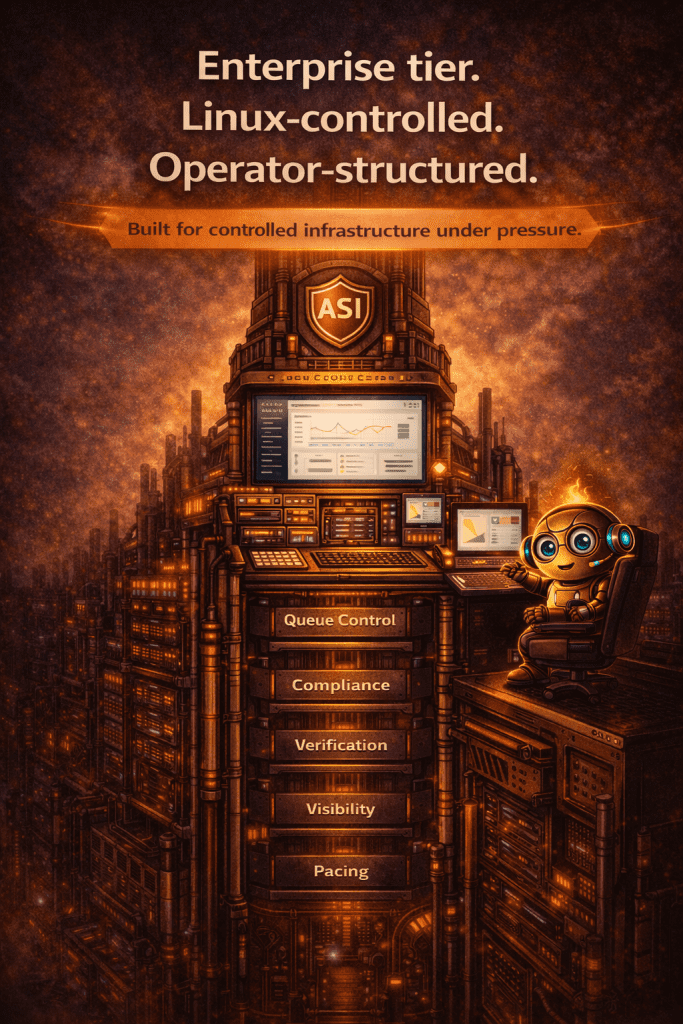
Enterprise scale must be proven under enterprise load.
ASI will not describe the 500,000 or 1,000,000-per-day systems as production-proven until the complete platform has passed sustained sending, queue, validation, reporting, evidence-write, archive, recovery, and operational-failure testing at the intended scale.
Why the enterprise edition is a separate system
At this volume, adding more horsepower to a smaller topology is not enough.
Different operating pressure
Enterprise volume creates heavier queue activity, validation demand, event writes, reporting load, bounce processing, storage pressure, and provider exposure.
Different infrastructure shape
The enterprise edition is designed around a full Linux-native control system with operational services separated according to proven load and resilience needs.
Different implementation path
Enterprise deployment requires discovery, data and infrastructure planning, implementation, training, controlled migration, acceptance testing, and a longer warm-up.
Different commercial commitment
These systems are intended as annual enterprise infrastructure agreements with a structured deployment engagement, not month-to-month self-service software.
Two enterprise operating classes are planned for 2027.
Final specification and acceptance limits will be published only after the relevant architecture has passed the required testing.
Up to 500,000 emails per day
Designed for organisations that need private high-volume sending with ASI Core, enterprise queue control, provider-aware pacing, validation, compliance, protected reporting, AOCR monitoring, and structured operational support.
Launch status: planned for 2027, subject to final performance and acceptance testing.
Up to 1,000,000 emails per day
Designed for larger operations requiring heavier infrastructure, bounded active-data growth, enterprise evidence handling, resilient queue and service separation, archive discipline, and stronger operational oversight.
Launch status: planned for 2027, subject to full-scale architecture proving.
Full Linux underneath. One protected ASI Core throughout.
The enterprise edition changes the deployment architecture, not the permanent ASI truth model.
SQL remains the Truth Engine
Subscriber, campaign, consent, suppression, eligibility, queue, sending, and evidence truth remain authoritative in SQL.
Linux-native control plane
Enterprise operators use a dedicated ASI control system designed around the underlying Linux services rather than a conventional website stack.
Separated services where proven
Queue, validation, sending, database, reporting, event, monitoring, and archive services may be separated according to the final tested topology.
Caches only accelerate
Redis and other cache layers may accelerate hot state and prepared views, but they never become an independent source of truth.
Protected evidence rails
Reports Builder, Event Stream, Recipient Drilldown, message traceability, bounce evidence, and audit records remain protected enterprise evidence surfaces.
Client-controlled data access
ASI staff do not receive unrestricted access to client data. Support, migration, and assisted services remain authorised, bounded, auditable, and least-privilege.
Enterprise ASI is installed, implemented, proven, and operated as infrastructure.
The planned enterprise commercial model reflects the work required to build a private operating environment properly.
Annual agreement
Enterprise licences are planned as annual agreements paid in advance, reflecting reserved infrastructure, support, monitoring, and operational responsibility.
Structured deployment
A planned deployment charge of $40,000 covers discovery, environment design, implementation, configuration, migration planning, training, proving, and controlled go-live.
Enterprise acceptance
The environment must pass agreed infrastructure, queue, validation, sending, reporting, evidence, recovery, and operational acceptance checks before normal enterprise use.
No self-service shortcut
Enterprise systems will not be delivered as a checkout purchase followed by a login email and a cheerful instruction to get on with it.
Final enterprise pricing, licence terms, deployment scope, and service levels will be published before launch and may change as testing defines the final production architecture.
Fifteen weeks to prove the enterprise sending environment.
The planned enterprise implementation uses a fifteen-week warm-up and proving period. The longer path reflects the larger intended operating volume, provider exposure, infrastructure complexity, migration risk, and need to validate repeatable behaviour under increasing load.
Evidence-led progression
The calendar provides the framework. Complaints, bounces, provider response, queue health, content evidence, engagement quality, and infrastructure stability decide progression.
Provider-aware growth
Google MX and other provider lanes can progress at different rates according to their own current evidence.
No automatic full capacity
Licensed capacity defines the planned operating ceiling. It does not create immediate permission to use that ceiling before the sender has earned it.
Acceptance before release
The final operating lane is released only after the environment and sender have demonstrated the required stability and evidence.
Enterprise scale requires bounded live data.
The live ASI environment is not designed to carry unlimited years of hot operational evidence. Enterprise storage policy separates active SQL truth, ASI-generated operational evidence, imported source data, and long-term audit archives.
Active evidence window
The production environment retains the data required for current operations, reporting, recovery, suppression, audit, and evidence-led decisions.
Earlier packaging at higher volume
At the highest planned volumes, packaging and archival activity is expected to begin earlier so the active SQL and evidence footprint remains bounded.
Source-specific retention
Imported commerce, CRM, API, support, or private-system data may require different retention, replay, deletion, and audit rules from ASI-generated send evidence.
Long-term audit archives
Clients may retain packaged historical evidence on designated archive servers, integrity-checked, encrypted, and governed by the client’s retention and deletion rules.
The 2027 launch depends on evidence, not enthusiasm.
The enterprise edition will not be released merely because the interface looks finished or a laboratory send reached the intended rate once.
Sustained queue and send load
The system must maintain controlled queue movement, pacing, holds, recovery, and accurate state under sustained enterprise-volume operation.
Reporting and evidence-write load
Reports Builder, Event Stream, recipient evidence, bounce processing, and message traceability must remain usable while heavy write activity continues.
Failure and recovery behaviour
Service failure, queue interruption, provider pressure, database stress, worker loss, archive faults, and controlled restart must be tested without losing Core truth.
Operational acceptance
AOCR, diagnostics, alerts, support packets, access controls, audit evidence, and operator workflows must remain clear enough to run safely in the real world.
Organisations that need email infrastructure, not another sending account.
The enterprise edition is intended for high-volume B2B operations, major commerce platforms, large sales-led organisations, controlled agency environments, and businesses where email continuity, evidence, private infrastructure, and sender reputation carry material commercial risk.
Not a shortcut to one million sends.
It is not designed for casual newsletters, purchased-list blasting, unauthorised multi-client service-bureau use, or organisations that want enterprise capacity without enterprise data quality, governance, implementation, and warm-up discipline.
Explore the current ASI platform
Before the 2027 enterprise launch, explore Sending Engine & Queue Control, Email Warm-Up, Google MX Protection, Campaign Reports & Insights, ASI Operations Control Room, and Migration & Merger Tools.
ASI Enterprise Linux launches in 2027.
Register your interest to discuss planned sending volume, data sources, provider mix, migration requirements, reporting needs, archive policy, operational controls, and whether the future 500,000 or 1,000,000-per-day enterprise path fits the organisation.