
A Large Click Total Is Not the Same as a Useful Audience
A campaign dashboard can show thousands of clicks and still fail to answer the question the business actually cares about.
Who is worth following up?
That is the problem with raw click totals.
They look decisive. They look commercial. They give the sales team a list, the marketing team a performance story and the board a number that feels pleasantly solid.
But a click total does not automatically mean human interest.
It means a link was requested.
That request may have come from a buyer.
It may have come from a security scanner.
It may have come from an automated system checking whether the link is dangerous.
It may have come from a mailbox provider, corporate filter, anti-phishing tool or privacy system behaving exactly as designed.
The dashboard still counts the activity.
The business may then treat it as intent.
That is where the trouble begins.
The familiar assumption
Most campaign reporting trains people to believe that bigger numbers mean better performance.
More opens.
More clicks.
More engagement.
More opportunities.
The assumption is understandable. For years, email marketing platforms have taught users to treat opens and clicks as clean indicators of audience behaviour.
If 4,000 people clicked, surely 4,000 people showed interest.
If one link received ten times more clicks than another, surely that product deserves more attention.
If a recipient clicked the pricing link, surely the sales team should call them first.
The problem is that modern email is not handled only by humans.
Security tools inspect messages. Links are rewritten. URLs are checked. Remote content may be loaded through privacy systems. Some activity happens before the recipient ever reads the email.
A raw click total is therefore not a simple count of people raising their hands.
Sometimes it is a room full of smoke alarms testing the doors.
Useful, but not the same as customers asking for a quote.
What nonhuman interactions do to campaign data
The Messaging, Malware and Mobile Anti-Abuse Working Group has written directly about this problem in its paper on nonhuman interactions and email send metrics.
M3AAWG explains that received email may be handled partly or fully by software, not just by a human. During security scans, systems may follow links inside an email, visit the target website and analyse the content. That activity can be recorded by campaign systems as a click or open.
That matters because the activity was not necessarily commercial interest.
The scan may have been checking whether the link pointed to phishing, malware or other unsafe content. From the security system’s point of view, that is good behaviour. It protects recipients.
From the marketer’s point of view, it can create a very convincing lie.
Not a malicious lie.
A system lie.
The kind of lie that appears when one system records a technical event and another person gives it a commercial meaning it never earned.
Security scanning is not the enemy
This is not an argument against link scanning.
Security scanning exists because malicious links are a real problem. A modern inbox is not a polite garden party. It is a border crossing with fake passports, suspicious packages and someone in the corner pretending to be finance.
Microsoft’s documentation for Safe Links in Defender for Office 365 describes protection that scans URLs and helps protect users from malicious links. Google also operates Safe Browsing, which lets applications check URLs against lists of unsafe web resources such as phishing or malware sites.
These systems are not trying to ruin a campaign report.
They are trying to stop people being harmed.
The reporting problem appears when a marketing platform records technical inspection as recipient engagement without enough explanation, filtering or confidence context.
A scanner following links is not a buyer comparing products.
A corporate security system checking every URL is not a prospect reading your offer.
A mailbox provider inspecting content is not a warm lead.
Yet many campaign dashboards compress all of this activity into one cheerful click number.
That number may still be useful.
But only if the system explains what it can and cannot prove.
Opens have the same problem in different clothing
Clicks are not the only engagement metric affected by modern privacy and security behaviour.
Apple’s Mail Privacy Protection explains that email senders may otherwise learn when and how many times an email was opened, whether it was forwarded, the recipient’s IP address and related data. Mail Privacy Protection is designed to limit that kind of tracking by changing how remote content is handled.
That is good for user privacy.
It also means raw opens are a weaker signal than many dashboards still pretend.
An open may not mean the recipient sat down with a cup of coffee and read every line.
A click may not mean the recipient wanted to buy.
The old reporting language makes these events feel human.
Modern email behaviour makes that unsafe.
The commercial cost of believing the wrong number
Inflated click data does not just make a report look prettier.
It changes decisions.
A sales team may spend hours chasing contacts who never clicked.
A marketing team may decide the wrong subject, offer or product worked.
A manager may increase budget because the campaign appears to have generated strong engagement.
A sender may keep emailing people who appear active only because automated systems keep touching the links.
A board report may show performance that cannot be defended when someone asks, “What does this number actually mean?”
That last question is the important one.
What does the number actually mean?
If the answer is “a link was requested by something,” the business should not treat that as a sales opportunity.
If the answer is “this recipient showed evidence consistent with human interest,” that is more useful.
Still not perfect.
But more useful.
Raw reporting rewards noise
The danger with raw click totals is that they reward the noisiest activity.
A campaign may look successful because several corporate domains scanned every link in the message.
A pricing page may look popular because it was inspected repeatedly.
A specific recipient may appear highly engaged because their mailbox-security environment behaved aggressively.
The marketer sees heat.
The system may simply be detecting machinery.
This is how sales teams end up with poor follow-up lists.
It is also how marketing decisions become distorted.
A campaign can be optimised around activity that did not come from buyers. Segments can be created from false engagement. Automations can be triggered by systems rather than people.
M3AAWG warns that nonhuman interactions can affect business decisions, list hygiene and engagement-based segmentation. Its guidance also notes that there is no definitive way to remove all nonhuman interaction with perfect certainty.
That matters because any serious reporting system should be honest about uncertainty.
Pretending the problem does not exist is easier.
It is also how the dashboard turns into a glitter cannon full of fog.
The better operating principle
If a system makes the claim, the system owns the evidence.
That should be the standard.
A campaign report should not merely say “clicks.”
It should help the operator understand what kind of clicks were recorded.
Raw activity is one layer.
Filtered activity is another.
Human-confidence evidence is another again.
The difference matters because each layer answers a different question.
Raw reporting asks:
How much activity did the campaign record?
Filtered reporting asks:
How much activity looks less likely to be automated noise?
Human-confidence reporting asks:
Which events have enough supporting evidence to be treated as more useful for human follow-up?
Those are not the same question.
They should not be collapsed into one number and handed to the sales team with a tiny party hat.
How ASI approaches campaign evidence
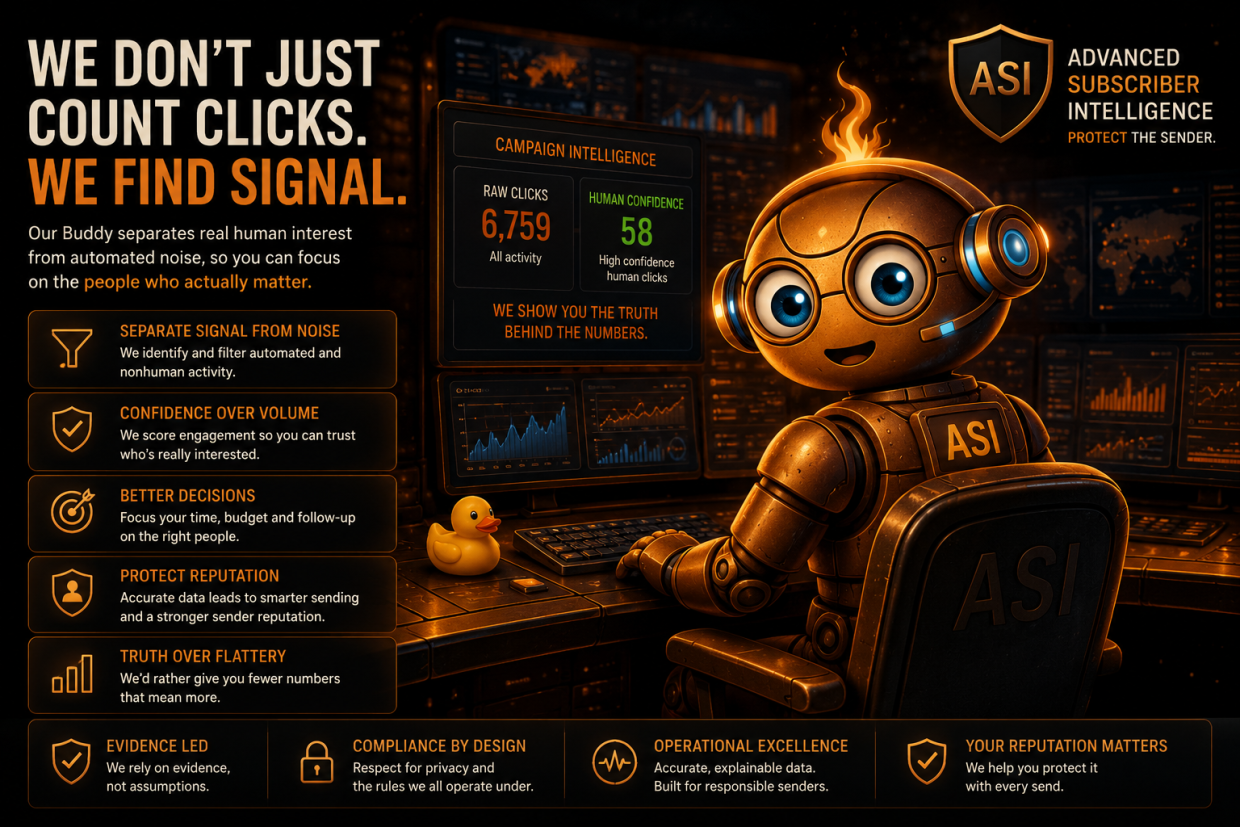
ASI does not treat every click as equally meaningful.
Its reporting approach separates raw campaign activity from confidence-led evidence so operators can understand the difference between noise, possible interest and stronger human signals.
That does not mean ASI claims perfect bot detection.
It does not mean every click can be labelled with certainty.
It does not mean a confidence score becomes a legal or commercial fact.
ASI reporting provides up to 92% accurate operational data. The “up to” matters because confidence is evidence-led, not theatrical.
Some events may carry weak evidence.
Some may sit in a middle band.
Some may reach stronger confidence levels.
Scores can sit anywhere from 0% to 92%, with common milestones such as 68%, 86% and 92% helping operators understand the strength of the evidence without pretending certainty where the system cannot prove it.
The purpose is not to make the dashboard smaller for sport.
The purpose is to make the dashboard more useful.
A smaller number that can be explained is more valuable than a larger number that collapses under questioning.
What useful reporting should help you do
Useful reporting should help a business make better decisions.
It should help sales teams decide who deserves attention.
It should help marketers understand which content genuinely appears to work.
It should help managers avoid budget decisions based on inflated activity.
It should help the sender protect reputation by not confusing automated noise with healthy engagement.
It should also preserve the raw evidence.
Raw activity still matters. It can reveal scanning behaviour, provider patterns, unusual domain activity and campaign anomalies. The mistake is not recording it.
The mistake is pretending raw activity and useful human evidence are the same thing.
A serious reporting system should show both.
The operator should not have to guess which number is the ornament and which number is the tool.
The question behind the dashboard
The most useful question is not:
How many clicks did we get?
It is:
How much of this activity can we defend as useful evidence?
That question changes the way campaign reporting works.
It moves the business away from vanity totals and towards operational proof.
It protects sales teams from chasing ghosts.
It protects marketing teams from optimising around machines.
It protects management from acting on numbers that look confident but cannot explain themselves.
A large click total can be comforting.
Useful evidence builds better decisions.