
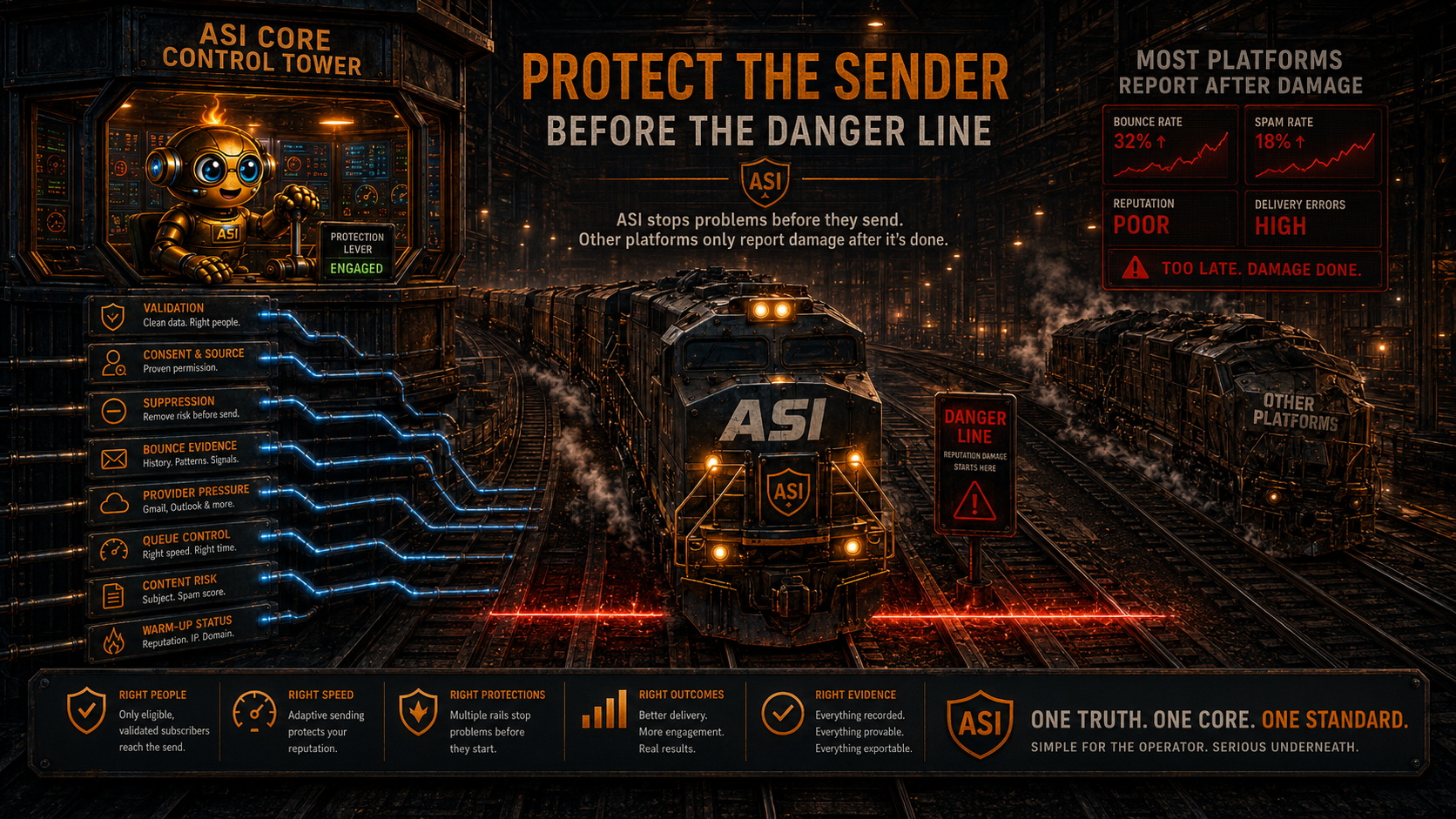

Most Platforms Report Reputation Damage After It Happens
Most platforms are very good at telling you something went wrong.
The bounce rate rose.
The spam rate moved.
The domain reputation changed.
The delivery errors appeared.
The campaign that looked safe yesterday now has a red warning sitting beside it like a tiny legal department with a headache.
That information matters.
But by the time sender reputation damage is visible, the sender may already be paying for the decision that caused it.
The more useful question is not: What happened?
It is: What should the system have done before the sender reached the danger line?
The familiar assumption
A lot of email platforms are built around reporting.
They show campaign status, sends, bounces, opens, clicks, unsubscribes and complaints. Some connect to reputation tools. Some display provider signals. Some warn when numbers begin to look uncomfortable.
That feels responsible.
The operator can see the result, review the dashboard and decide what to do next.
The problem is timing.
Reputation damage is not usually a single dramatic event. It builds from patterns: poor list quality; too many invalid or risky recipients; weak consent evidence; complaints; repeated bounces; sudden volume changes; provider-specific rejection patterns; content that triggers filtering; sending too hard into a sensitive mailbox provider.
The dashboard may report the symptom clearly.
But reporting a symptom is not the same as preventing the injury.
A smoke alarm is useful.
A platform that keeps pouring petrol while admiring the smoke alarm is less useful.
Reputation signals often arrive after the behaviour
Google’s own guidance makes this timing problem clear.
Its email sender guidelines advise senders to monitor server responses, spam rate and the sending domain’s reputation as volume increases.
The guidance also says that if messages start bouncing or being deferred, senders should reduce sending volume until the SMTP error rate decreases.
That is good operational advice.
It also proves the point.
The sender is being told to react to signals that indicate pressure is already showing.
Postmaster data is valuable, but it is not a magic shield around the send button. Google’s Postmaster Tools dashboard documentation explains that the dashboards show data such as spam rate, reputation, authentication and delivery errors for outgoing mail to personal Gmail accounts.
Those dashboards help a sender understand what is happening.
They do not make the risky send safe before it happens.
A serious sending platform should use visible reputation signals as part of the evidence picture, but it should not wait for provider damage to become obvious before applying discipline.
The hidden problem
Many systems treat reputation protection as something that happens after the campaign has left.
The operator imports the list.
The platform accepts the addresses.
The campaign queues.
The send begins.
Then the reports arrive.
If the numbers are poor, the system may warn the operator next time.
That model assumes the sender can afford to learn from the damage.
High-volume senders often cannot.
If the sender pushes a weak list into a sensitive provider, the consequences may not stay inside that one campaign. A poor decision can affect later sends, future campaigns, sales activity, warm-up progress and the confidence of the whole sending environment.
The issue is not that dashboards are bad.
The issue is that dashboards are often asked to do the job of controls.
A dashboard explains.
A control intervenes.
Those are different jobs.
Reputation is not one number
Sender reputation is not a single dial on the wall.
Spamhaus explains in its guide to how email reputation works that reputation is made up of many variables, many of which receivers and reputation providers do not fully reveal. Spamhaus points to factors such as bounces, invalid addresses, spam traps, list management and engagement.
That matters because senders do not always know which behaviour caused the shift.
A campaign may look acceptable in one dashboard but create pressure elsewhere.
Google may behave differently from Microsoft.
A consumer mailbox provider may react differently from a corporate gateway.
A dedicated IP may have different needs from a shared environment.
A domain with a strong history may tolerate pressure differently from one still warming up.
This is why treating all recipients and all providers the same is operationally lazy.
Convenient, yes.
Safe, no.
Reputation protection needs to understand the sending context, not just count the campaign after the fact.
Bounce pressure is a warning, not an accounting category
Bounces are often treated as ordinary campaign housekeeping.
A few hard bounces here.
A few soft bounces there.
Some deferrals.
A list-cleaning job later.
This is too casual for serious sending.
Bounce behaviour tells receiving systems something about the sender. It can suggest poor data quality, old records, weak list hygiene or careless acquisition.
M3AAWG’s Sender Best Common Practices says it is recommended practice to remove addresses from a list if they consistently bounce over multiple campaigns.
That is a basic hygiene rule.
But ASI’s view is that high-volume senders should not merely clean up after repeated damage.
They should use bounce evidence earlier, as part of the decision about whether a recipient, segment or provider lane should continue receiving pressure.
A bounce is not just a failed delivery.
It is evidence.
And evidence should change system behaviour.
The commercial cost of late protection
Late reputation protection creates costs that do not always appear in the campaign report.
A sender may lose sending capacity.
Inbox placement may weaken.
Campaign schedules may need to slow down.
Sales teams may be working leads from campaigns affected by poor placement.
Support staff may have to investigate complaints.
A consultant may be brought in after the warning signs are already visible.
Management may ask why a campaign was allowed to leave when the evidence was already uncomfortable.
The platform may be able to show the damage in a chart.
That does not answer the harder question:
Why was the campaign allowed to keep going?
This is where “we reported it” becomes a weak defence.
For serious senders, the system should not simply document the fall. It should put rails around the cliff edge.
The better operating principle
Sender reputation should be protected before the dashboard turns red.
That does not mean every warning should become a panic stop.
It does not mean a platform should block ordinary sending because one number looked at it funny.
It means the system should have the authority to slow, hold, separate or remove risk when the evidence justifies it.
The sender should not have to rely on an operator noticing three different warnings, understanding provider behaviour, remembering suppression logic, checking list quality, interpreting delivery errors and deciding the correct pacing response while also trying to get a campaign out before lunch.
That is not a workflow.
That is a small circus with DNS records.
A better system uses operational evidence before the send, during the send and after the send.
Validation evidence.
Consent and source evidence.
Suppression evidence.
Bounce history.
Provider behaviour.
Queue pressure.
Content risk.
Warm-up status.
Campaign eligibility.
Those pieces should influence whether a campaign can leave normally, whether part of the audience should be held, whether provider-aware pacing should change, or whether the operator needs a clear intervention before proceeding.
How ASI approaches the problem
ASI is designed around the principle: Protect the Sender.
That means sender protection is not treated as a report the operator reads later. It is part of the operating discipline before and during sending.
At a commercial level, ASI can help protect the sender by checking whether recipients should reach the send rail, whether a campaign is carrying avoidable risk, whether provider-specific pressure needs attention, and whether the operator should be stopped or warned before a poor decision leaves the platform.
ASI does not need to claim guaranteed inbox placement.
It does not need to pretend reputation can be perfectly controlled.
No serious system should make those claims.
Mailbox providers make their own decisions. Recipients behave in their own ways. Reputation systems use signals senders cannot fully see.
The honest promise is different.
ASI is built to reduce avoidable risk, preserve evidence and intervene earlier when the platform can see that the sender is being exposed.
That is the important shift.
From reporting damage to preventing avoidable damage.
From “the campaign was sent” to “the campaign was checked before it was allowed to leave.”
From “the dashboard says it went badly” to “the system had a responsibility to challenge the decision before the sender paid for it.”
Postmaster is evidence, not the driver
Provider tools are useful.
Google Postmaster Tools should be part of a serious sender’s visibility picture. Delivery errors, reputation indicators and spam-rate data can all help diagnose what is happening.
But Postmaster data should not become the only safety system.
It is provider evidence.
It is not the whole truth.
A responsible platform should combine provider signals with its own operational evidence, campaign evidence, validation evidence, suppression evidence and send behaviour.
It should also be honest when evidence is advisory rather than certain.
That is how sender protection should work.
Not as theatre.
Not as red buttons everywhere.
Not as a platform shouting “Danger!” after the damage has already become expensive.
As disciplined infrastructure that quietly asks:
Should this campaign continue exactly as planned?
Should this provider lane slow down?
Should these recipients be held?
Should this list be challenged?
Should the operator be warned before pressing Send?
Those are the questions that protect the sender.
Reporting damage is not enough
There will always be things a platform cannot fully control.
No system can guarantee inbox placement.
No system can guarantee complaint-free campaigns.
No system can guarantee that a provider will never react sharply to a campaign, a list or a sending pattern.
But a serious platform should be designed to reduce the avoidable damage.
It should not behave like the only job is to show the wreckage neatly afterwards.
Sender reputation is too valuable for that.
A platform that only reports damage is useful after the fact.
A platform that protects the sender before the danger line is crossed is doing the more serious job.
The dashboard should not be where reputation protection begins.
It should be where the evidence proves the system was paying attention before the sender got hurt.